


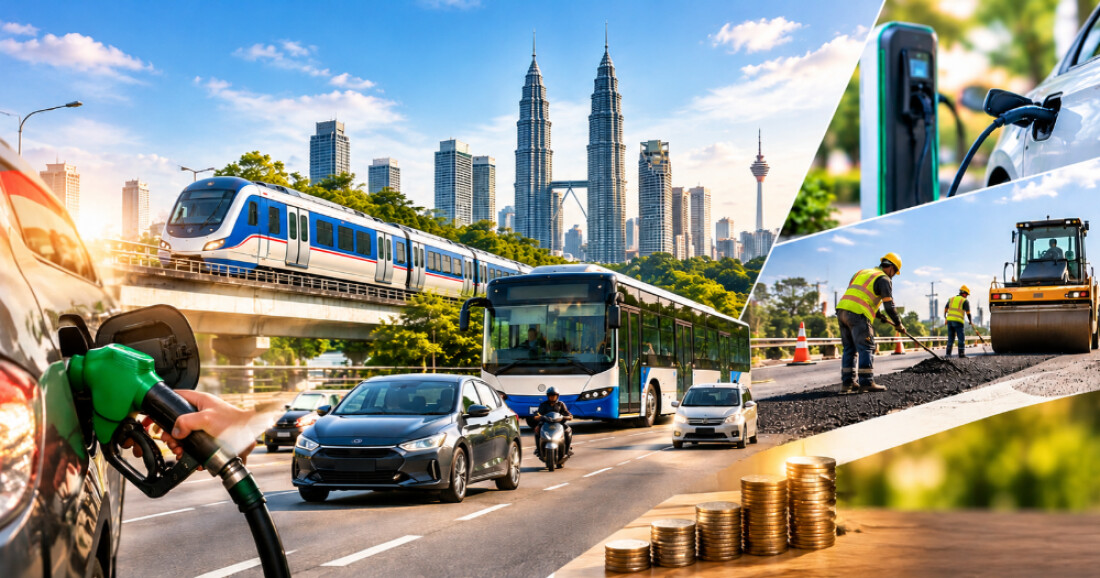
Budget 2027 introduces several measures affecting how Malaysians travel, from fuel subsidies and public transport to road maintenance, EV charging facilities and assistance for people who drive for a living.
Some benefits could make a difference to your wallet fairly soon. Others will take time to materialise.
🚗 Budget 2027: Here's The Short Version
Don't have time to read everything? Start here.
| If you're... | What you need to know |
|---|---|
| 🚗 A motorist | Fuel subsidies continue, but the RM40 billion allocation doesn't mean your quota will increase. |
| 🚆 A KTM Komuter user | MYKOMUTER50 is coming in 2027, with potential savings of up to RM160 monthly. |
| 🚕 An eligible transport driver | RM1,000 one-off assistance, with payments due to begin the week of 12 October 2026. |
| 🛵 A gig worker | A RM160 million package aims to improve earnings and welfare support. |
| ⚡ An EV owner | 50 additional highway charging facilities are planned. |
| 🚚 A commercial operator | Mandatory telematics is coming, subject to implementation rules. |
RM40 Billion For Fuel Subsidies. Does That Mean More Cheap Petrol?
Let's start with something almost every Malaysian driver cares about: fuel. Under Budget 2027, the government expects to spend approximately RM40 billion on fuel subsidies.
Sounds like a lot, right? It is. But that figure represents projected government spending, rather than a new cash benefit for individual motorists.
Existing programmes such as BUDI95 and BUDI Diesel continue under their respective eligibility rules. The Budget speech also refers to the BUDI95 quota increase to 300 litres, which was implemented before Budget Day rather than announced as a new benefit on 9 October.
⛽ DOES THIS MEAN MORE SUBSIDISED PETROL?
Not automatically. The RM40 billion allocation doesn't mean your individual BUDI95 or BUDI Diesel entitlement will increase.
MYKOMUTER50: Cheaper Train Rides Are Coming!
Now here's something regular KTM Komuter passengers might appreciate. Budget 2027 introduces MYKOMUTER50, a new initiative expected to benefit approximately 40,000 commuters next year.
Eligible passengers could save up to RM160 a month. For someone who takes the train to work almost every day, that's potentially a meaningful saving. However, KTMB has yet to confirm the full purchase conditions, covered routes and exact launch date.
Meanwhile, the existing My50 programme will continue for eligible Prasarana bus and rail passengers in the Klang Valley.
Free public transport passes will also continue for eligible groups, including schoolchildren, persons with disabilities and children under six.
🚆 BEFORE YOU PLAN YOUR COMMUTE
MYKOMUTER50 and My50 are different initiatives. MYKOMUTER50 is intended for KTM Komuter users, while My50 covers eligible Prasarana services. Don't assume the two passes are interchangeable.
For now, it's a promising announcement, particularly for Malaysians who already depend on KTM Komuter.
More Trains Are Coming. But Will Services Actually Improve?
Cheaper train fares are great. But anyone who's experienced a delayed train during rush hour knows that affordability is only half the battle.
Budget 2027 includes plans to acquire 42 new train sets for ETS and KTM Komuter, alongside more than RM3.4 billion in rail rehabilitation investment by Prasarana. Both measures are intended to improve public transport capacity and reliability.
Of course, new trains won't all appear on the tracks overnight. Procurement, delivery and commissioning take time, while rehabilitation work may be carried out in stages.
Meanwhile, the East Coast Rail Link (ECRL) is targeting December 2026 for the start of its first-phase operations between Kota Bharu and Gombak. The government has also highlighted plans to extend the railway towards Rantau Panjang.
To improve connectivity, RM270 million has been allocated for stage bus services, including connections involving 15 East Coast stations. Johor Bahru is also expected to benefit from improvements to bus and KTM Komuter services, alongside a proposed elevated Autonomous Rapid Transit system.
🚆 WHY THIS MATTERS
A railway is only truly convenient if passengers can reach the station easily and continue their journeys after getting off. That's why feeder buses, service frequency and last-mile connections matter just as much as the trains themselves.
These improvements could make public transport more practical, but delivery timelines and actual service performance will determine how much commuters benefit.
RM1,000 For Taxi And School Bus Drivers, With Payments Starting Soon
Here's one announcement that doesn't require waiting until 2027. Eligible taxi, hire-car and school bus drivers will receive RM1,000 in one-off financial assistance, with payments scheduled to begin during the week of 12 October 2026.
The assistance is expected to benefit approximately 53,000 drivers nationwide, comprising 38,000 taxi and hire-car drivers and 15,000 school bus drivers.
Interestingly, the money comes from proceeds raised through the special H-series vehicle registration number auction. According to
New Straits Times
, disbursement is expected to begin during the week of 12 October.
💰 WHO GETS THE RM1,000?
The announcement covers eligible taxi, hire-car and school bus drivers. However, payments beginning next week doesn't mean everyone will receive the money on Monday. Individual payment dates and any necessary procedures should be confirmed through JPJ's official announcements.
RM160 Million For E-Hailing Drivers And Delivery Riders
If you drive for an e-hailing platform or deliver food and parcels, Budget 2027 also has something worth noting. The government and Grab will jointly fund a RM160 million package aimed at improving the earnings and welfare of e-hailing and p-hailing workers.
The package includes support involving vehicle maintenance, insurance and social protection.
According to
Bernama's Budget coverage
, median net monthly earnings are projected to increase by up to RM227 for e-hailing drivers and RM100 for delivery riders.
But here's the catch. Those figures are projected improvements, not guaranteed monthly cash payments.
There's also additional support for social protection, including PERKESO matching contributions starting at 35%, potentially increasing to 50% where platform companies contribute.
For drivers and riders, the real value will depend on how much of that support actually reaches them, particularly when maintenance, insurance and other operating costs are taken into account.
What should gig workers check? Look out for the final eligibility rules, how assistance will be distributed and which benefits apply to your particular platform. Not every measure will necessarily work like a direct cash payment.
EV Owners, Here's Some Good News About Charging Facilities
Thinking about switching to an EV but worried about charging during long-distance journeys? Budget 2027 includes plans for 50 additional EV charging facilities at strategic highway locations, through the Malaysian Highway Authority (LLM).
That's welcome news, particularly for drivers who regularly travel between states. However, the government has yet to provide the complete list of locations, charging speeds or commissioning dates.
And there's another detail worth clarifying. Fifty charging facilities doesn't necessarily mean 50 individual charging plugs. The number of connectors available at each location will depend on the eventual installation.
For EV owners, the real test will be where these chargers are installed, how fast they can charge and whether they're operational when needed.
Better Roads, More Motorcycle Shelters And CCTV Cameras
Now, here's something that could affect practically every Malaysian road user. Budget 2027 includes several allocations for road maintenance and improvements.
According to
The Star's Budget reporting
, these include:
- RM2.5 billion for federal road maintenance.
- RM5.7 billion through MARRIS for state road maintenance.
- RM40 million to help district engineers accelerate smaller maintenance works, including pothole repairs.
For motorcyclists, LLM also plans to provide 15 motorcycle shelters, while another 70 CCTV cameras are planned along the PLUS highway. These are practical measures, especially considering how frequently road conditions and safety concerns affect everyday journeys.
But there's an obvious question.
🛣️ WILL THIS FINALLY FIX THE POTHOLES NEAR YOUR HOUSE?
Possibly, but a national allocation doesn't tell us which roads will be repaired first. What matters next is how the funding is distributed, which locations are prioritised and how quickly repairs are completed.
That's the difference between announcing a road maintenance budget and motorists actually enjoying better roads.
Commercial Vehicles Will Need Telematics. What Does That Mean?
This is another announcement worth paying attention to, particularly for commercial vehicle operators. Budget 2027 reinforces the government's move towards mandatory telematics systems for commercial vehicles.
If you're wondering what telematics means, think of technology that can monitor a vehicle's movement and driving behaviour. Depending on the system, it can help track speed, location and potentially dangerous driving patterns.
The government has also discussed integrating alcohol detection technology to improve commercial vehicle safety.
However, the announcement doesn't mean every commercial vehicle operator must install a system immediately. Earlier plans involved voluntary adoption and awareness efforts before mandatory requirements are introduced in phases.
Operators will need to watch for the final technical requirements, compliance dates and licensing conditions, especially as equipment and ongoing subscription costs could affect their businesses.
Tougher Action Against Drink-Driving And Drug-Driving?
Road safety is also getting attention under Budget 2027. The government has announced plans to amend the Road Transport Act 1987 to strengthen accountability for drivers involved in accidents while under the influence of alcohol or drugs.
However, the specific amendments and their implications will only become clearer once the proposed legislative changes are detailed.
⚖️ ARE THE NEW RULES ALREADY IN FORCE?
No. This is currently an announced legislative proposal. Existing laws remain applicable unless and until the amendments are passed and brought into force.
FlySiswa Assistance Goes Up To RM500
For students who frequently travel between Peninsular Malaysia, Sabah and Sarawak, here's another announcement worth knowing.
Budget 2027 increases FlySiswa assistance from RM400 to RM500 for eligible students. That's an additional RM100 compared with the previous amount.
While it won't necessarily cover the entire cost of a flight, it could help reduce travel expenses, particularly for students returning home during semester breaks.
RM5 Million Tax Deduction For Automotive Vendors Moving To Tanjong Malim
Budget 2027 also includes an incentive for Malaysia's automotive manufacturing industry. Eligible wholly Malaysian-owned automotive vendors relocating to the Automotive Hi-Tech Valley (AHTV) in Tanjong Malim can qualify for a tax deduction on relocation expenses, capped at RM5 million, for qualifying expenditure incurred between 1 January 2027 and 31 December 2030.
The aim is to encourage suppliers to operate closer to manufacturers and strengthen the local automotive supply chain. However, this is a tax deduction, not a cash grant or consumer rebate, so it doesn't automatically mean cheaper cars. For more context, Carz previously covered
Proton's Budget 2027 proposals involving localisation and electrification
.
So, Is Budget 2027 Actually Good News For Malaysian Motorists?
Well, that depends on how you travel. If you're an everyday car owner hoping for a new vehicle purchase rebate or a bigger fuel subsidy, Budget 2027 may not deliver the immediate savings you were looking for.
But if you're a KTM Komuter passenger, an eligible taxi driver or someone earning a living through e-hailing, there are announcements that could make a more direct financial difference.
For EV owners, additional highway charging facilities could make long-distance travel more convenient. Meanwhile, new trains, road maintenance funding and transport safety measures are intended to improve everyday journeys.
Ultimately, Budget 2027 looks more promising for commuters and those who drive for a living than for ordinary car buyers hoping for immediate savings. For everyone else, the real test is whether these announcements eventually translate into smoother journeys, safer roads and fewer everyday frustrations.
Watch The Full Budget 2027 Presentation
Want to hear the announcements directly? Watch the full Budget 2027 presentation below.
Watch on YouTube if the player is unavailable.
Budget 2027 FAQ: What Malaysians Need To Know
1. Does Budget 2027 increase my BUDI95 or BUDI Diesel quota?
The RM40 billion fuel subsidy allocation doesn't automatically increase individual quotas. Your entitlement depends on the rules of the relevant subsidy programme.
2. When can I buy MYKOMUTER50?
MYKOMUTER50 has been announced for 2027. Its exact launch date, purchase conditions and route coverage still need to be confirmed by KTMB.
3. When will eligible taxi and school bus drivers receive RM1,000?
Disbursement is scheduled to begin during the week of 12 October 2026. Individual payment dates and any required procedures should be checked through official JPJ announcements.

CAR LISTINGS
NEWS & REVIEWS
JOIN US
ABOUT US
SUBSCRIPTION & SOCIAL MEDIA
Download the App